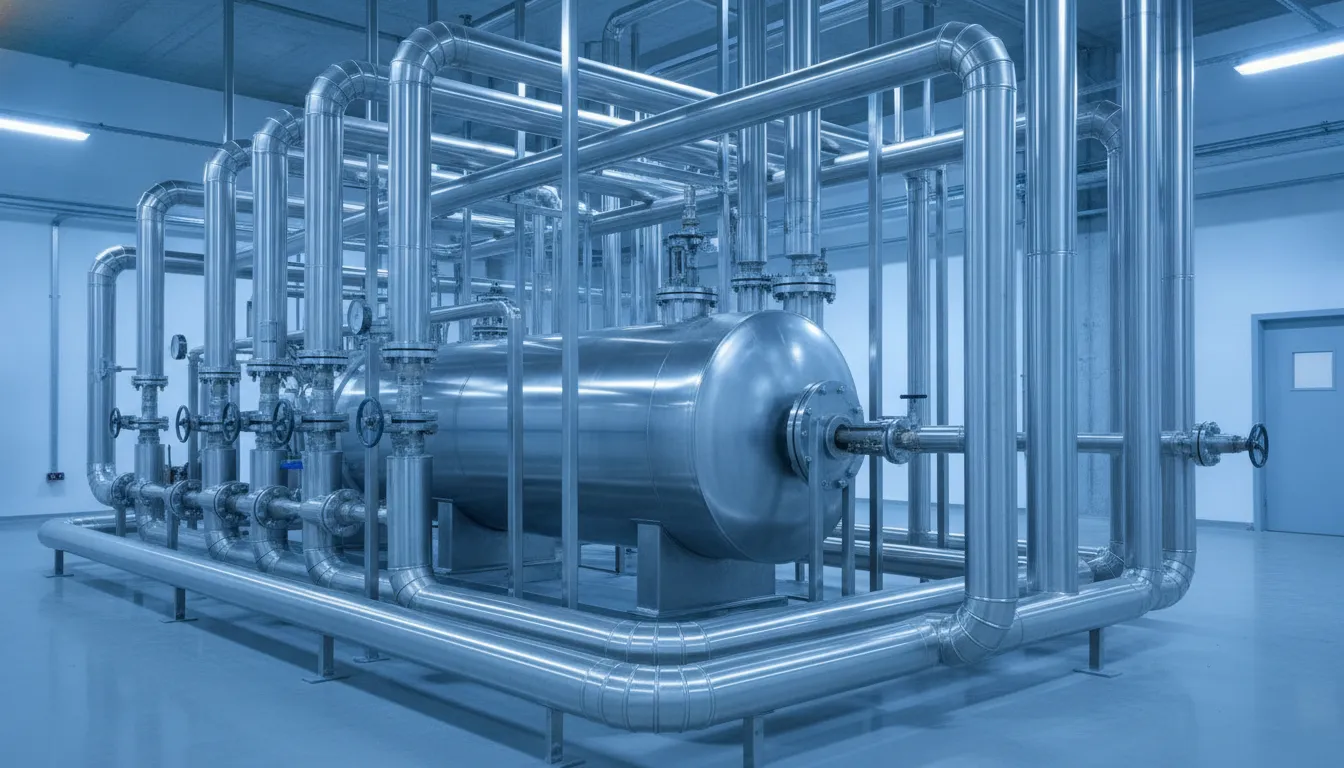
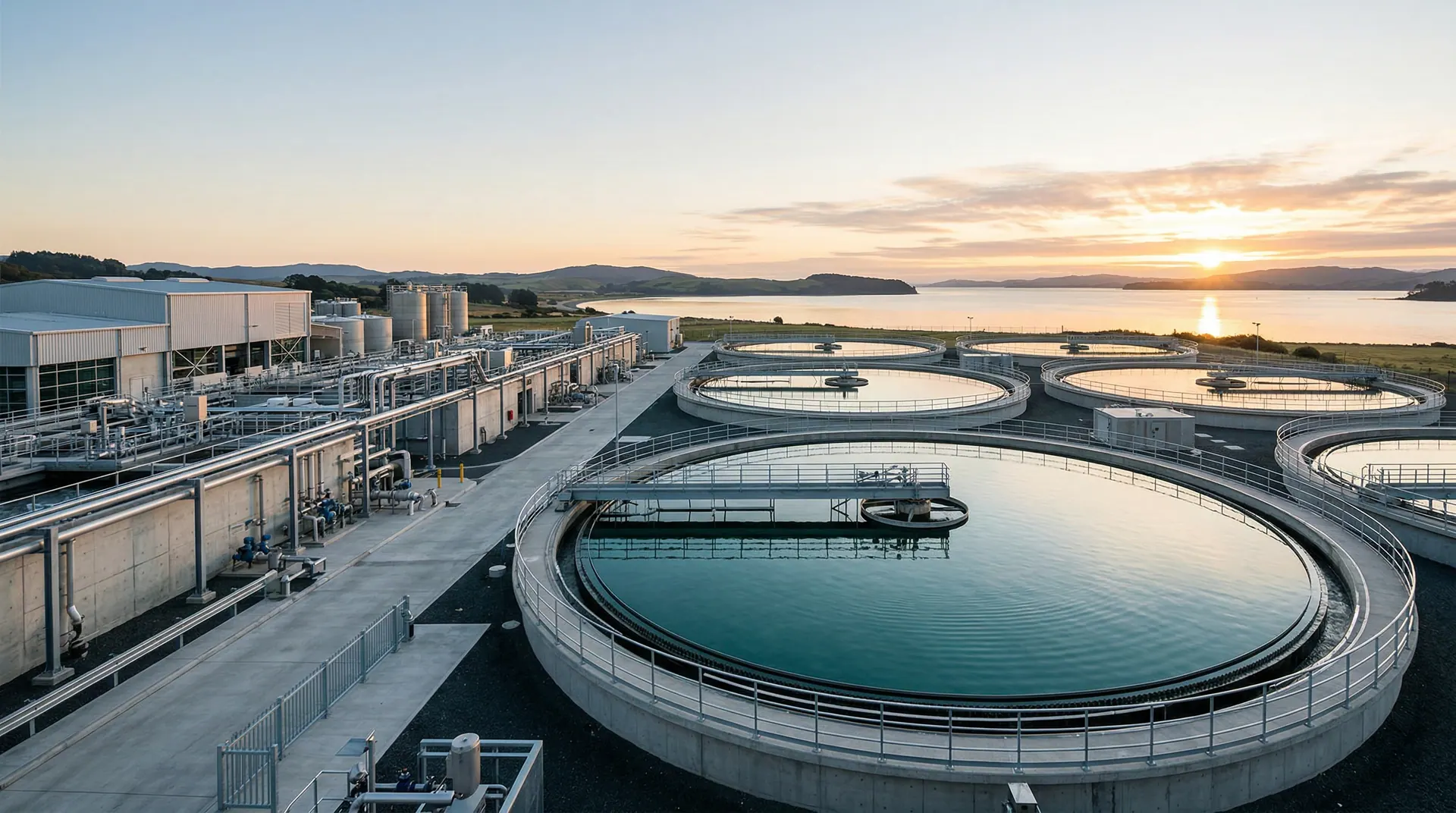
Why boiler chemistry starts in the water treatment ahead of it: scale, oxygen corrosion and carryover, the role of deaeration, condensate return and correctly set blowdown.
A boiler differs from every other water circuit in one respect: it contains a phase change. Steam leaves clean, while everything dissolved in the feedwater stays behind and accumulates. So even water of acceptable quality, fed untreated, leads to deposits sooner or later — the only question is how soon.
From which follows the main rule: boiler chemistry starts not in the boiler but in the water treatment ahead of it. Whatever was not removed before the boiler has to be held under control inside it — and that is always more expensive.
Three problems in a boiler circuit
Scale
Hardness salts deposit on the hottest surfaces, exactly where heat transfer happens. Scale acts as insulation: to transfer the same heat, the metal runs hotter. The result shows up twice — in fuel consumption and in tube life, because overheated metal loses strength.
Corrosion
The main driver is dissolved oxygen arriving with the feedwater. Oxygen corrosion is localised: it produces not uniform thinning but pitting, which leads to through-wall failures while the metal looks broadly sound. A separate problem is carbonic acid corrosion in condensate lines, where CO2 travels with the steam.
Carryover and steam contamination
At high dissolved solids or excess suspended matter, droplets of boiler water are carried over with the steam. That fouls the superheater and steam-consuming equipment, and in plants where steam contacts product it becomes a quality issue as well.
Feedwater: where most of the problem is settled
Almost everything that happens inside the boiler is determined by what entered it.
Softening
Removing hardness salts is the base stage, without which the rest loses meaning. Hardness is what forms scale, and removing it before the boiler is incomparably cheaper than holding it in solution inside.
Demineralisation
Where requirements exceed what softening can deliver. The fewer salts arriving with feedwater, the less blowdown is needed and the less heat is lost with it.
Deaeration
Thermal removal of dissolved gases, principally oxygen. Residual oxygen is then scavenged chemically. A deaerator running off-regime is the most common cause of corrosion damage in the feedwater train.
Condensate return
Condensate is the most valuable water on site: hot and essentially salt-free. Every kilogram not returned is replaced by make-up that has to be treated and heated again. But condensate needs monitoring — process fluid entering through a leak turns the advantage into a problem.
In-boiler treatment
The internal programme deals with what remains after water treatment: scavenging residual oxygen, holding alkalinity inside its working range, converting residual hardness into a mobile sludge that leaves with blowdown, and protecting the condensate system.
Residual oxygen is scavenged with sodium metabisulfite and sodium bisulfite. Alkalinity is corrected with caustic soda and other pH regulators. Scale and corrosion protection uses antiscalants and anti-corrosion reagents.
Blowdown: why it can be neither skipped nor guessed
Blowdown is the only way to remove accumulated salts from a boiler. Too little leads to rising dissolved solids, carryover and deposits. Too much is discarded heat, because the water leaving carries energy already spent heating it.
So blowdown is controlled by boiler water readings, not by a schedule or by habit. It is one of the few settings where both excess and shortfall cost money directly and measurably.
Common mistakes
- Saving on water treatment expecting chemistry to compensate. Internal treatment does not replace softening; it is sized for residual quantities, not for the main load.
- The deaerator running off-regime. The boiler looks fine while corrosion proceeds in the feedwater train, where it is invisible until failure.
- Blowdown by habit. Set once at a different load, it either wastes heat or fails to keep up.
- Condensate returned without monitoring. One leaking exchanger and process fluid goes into the boiler.
- Reagents dosed but results not measured. Dosing without residual monitoring means the programme is running blind.
- Idle boilers left unpreserved. A stopped boiler with air and moisture inside corrodes faster than a running one.
Frequently asked questions
Can softening be skipped if good reagents are used?
No. The reagent programme is designed for residual hardness, not for the bulk of it. Trying to hold the full load chemically produces heavy sludge, increased blowdown, and ends up costing more than treating the water.
How do we know scale has formed inside?
From indirect signs: fuel consumption rising at the same steam load, higher flue gas temperature, localised surface overheating. The direct method is inspection during a shutdown.
What should be done when a boiler is idle?
Lay-up, wet or dry depending on the duration and conditions. A boiler left unpreserved accumulates damage that surfaces at the next start.
How important is condensate return?
Very. It saves water, fuel and reagents at the same time, because condensate is hot and nearly salt-free. But the return must be monitored — contaminated condensate is worse than none.
Getting started
Start with an analysis of the raw and feedwater and a check of how the deaerator is actually running. Those two things explain most boiler circuit problems. More on the approach in water treatment; questions through the contact form.