Micro-, ultra-, nanofiltration and reverse osmosis: how the stage is chosen, why a tighter membrane is not better, and what pretreatment decides.
Membrane technologies are often discussed as a choice between acronyms: microfiltration, ultrafiltration, nanofiltration, reverse osmosis. In practice the choice is made differently — from what exactly has to be removed and what has to stay. A membrane does not "clean water" in general; it separates particles above a certain size, and everything else follows from that.
The logic of the series: from solids to dissolved salts
All four technologies work on the same principle — water is forced through a semi-permeable barrier — but they retain different things.
Microfiltration
The coarsest barrier in the series. It retains suspended solids and some microorganisms while dissolved salts pass freely. It is often used as a pretreatment stage ahead of finer membranes rather than as a standalone solution.
Ultrafiltration
Retains colloids, large organic molecules and microorganisms, leaving dissolved salts in the water. Good where turbidity and biological load must go but desalination is not required. It is frequently installed ahead of reverse osmosis precisely to stabilise feed quality.
Nanofiltration
An intermediate stage: it partially retains hardness salts and larger dissolved molecules while passing a significant share of monovalent ions. A sensible choice where water needs softening and organics removal but full desalination would be excessive.
Reverse osmosis
The tightest barrier: it retains practically all dissolved salts. It needs the highest pressure and the most careful pretreatment. More in the separate article on reverse osmosis systems.
How the stage is selected
The rule is simple: choose the coarsest barrier that solves the problem. A tighter membrane means not only higher quality but higher pressure, higher energy consumption, stricter pretreatment requirements and more expensive operation.
A typical mistake is installing reverse osmosis where ultrafiltration would do, because "it is safer that way". The result is excess quality, unnecessary cost, and demineralised water where merely clean water was needed. Sometimes it then has to be remineralised, which is waste on top of waste.
Pretreatment determines everything else
This is the most underestimated part of membrane projects. A membrane is not a coarse filter; it is designed for water that has already been prepared. What has to be removed ahead of it:
- Suspended solids. They block channels and surface, raise differential pressure and force frequent cleaning.
- Iron and manganese. They oxidise and deposit directly on the membrane, and are difficult to clean off.
- Free chlorine and other oxidisers. Polyamide membranes are destroyed by them irreversibly. This is not fouling that can be washed away but the death of the element.
- Salts prone to precipitation. On the concentrate side their solubility can be exceeded; they are held in solution by antiscalant.
- Biological load. Biofilm on a membrane grows by itself and returns after cleaning if the source has not been removed.
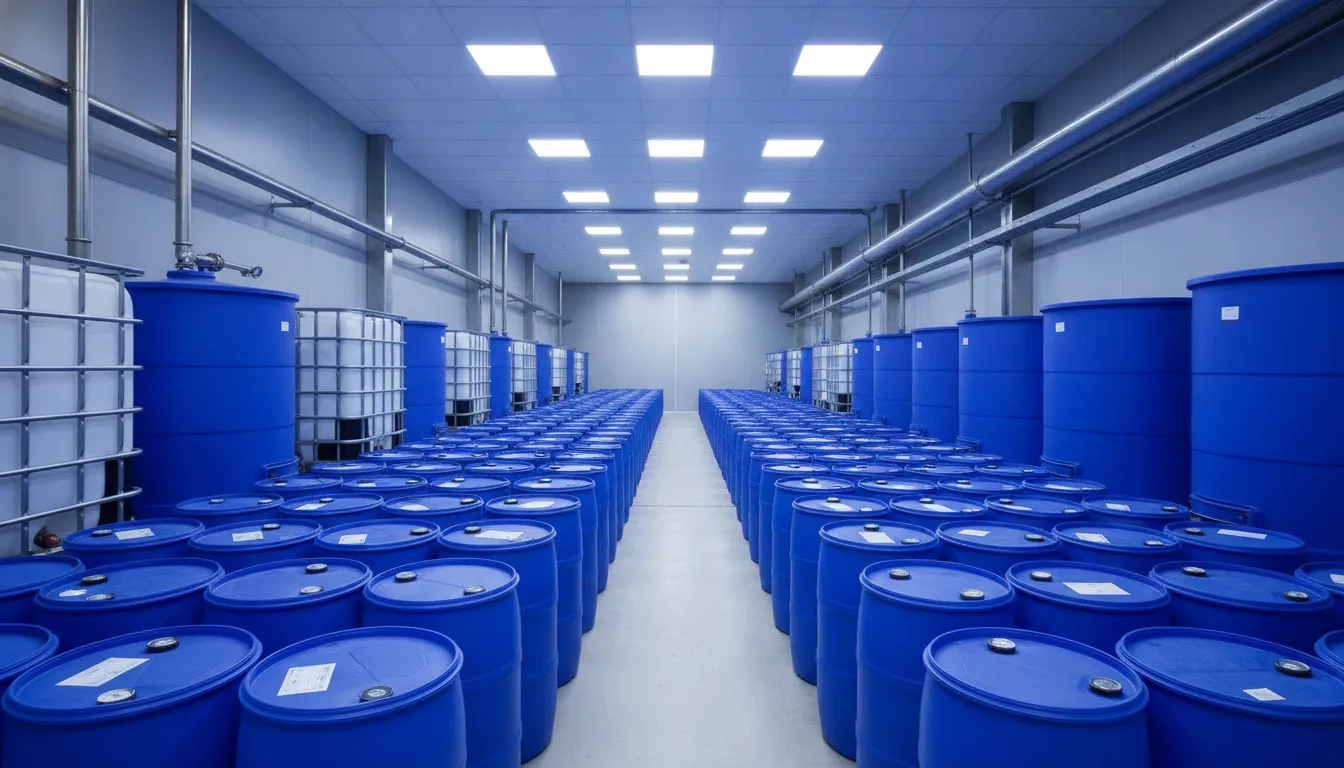
The mechanical stage uses filter media; dechlorination uses sodium metabisulfite.
What happens to a membrane in service
A membrane does not wear out evenly — it fouls, and the nature of the fouling determines what to do. Particulate fouling shows up as rising differential pressure, usually at the first stage. Scaling shows up as falling output and rising salt passage, usually at the last. Oxidation gives a sharp rise in salt passage while flow stays normal. Biofouling builds gradually and returns after cleaning if the cause was not addressed.
Distinguishing these matters, because cleaning is matched to the fouling type: alkaline removes organics and biofilm, acid removes mineral scale. Cleaning "just in case" with the wrong chemistry does not help and consumes membrane life.
Common mistakes
- Saving on pretreatment. The most expensive saving in membrane projects: the membrane starts working as a coarse filter and loses several times its life.
- Choosing technology "with margin". A tighter membrane than needed is a permanent overpayment in pressure and operating cost.
- Cleaning by calendar. Cleaning should follow readings; premature cleaning consumes life, late cleaning makes part of the fouling irreversible.
- Readings are not normalised. Output depends on temperature and pressure; raw values cannot be compared, and degradation is noticed too late.
- Dechlorination is not monitored. One failure at that point costs a set of membranes.
Frequently asked questions
How do we know which stage we need?
From the requirement for the treated water, not from which technology is newer. If turbidity and microorganisms must go — ultrafiltration. If dissolved salts must go — reverse osmosis. If the requirement sits between them, nanofiltration is worth considering.
How long do membranes last?
It is set not by the manufacturer but by pretreatment quality and cleaning discipline. Operated correctly, life is measured in years; with dechlorination failures, in months.
Can a heavily fouled membrane be recovered?
Partly, and not always. Fresh fouling comes off with cleaning. Compacted deposits come off partly, and oxidative damage does not recover at all.
Do we need a membrane if the water is already reasonable?
Not always. Sometimes filtration and softening are enough. A membrane is justified where the water requirement exceeds what conventional stages can deliver.
Getting started
Start with a water analysis and a clear statement of the permeate requirement — those two documents decide the stage. More on selection in water treatment; reagents and media in products. Questions through the contact form.