
Between the calculated dose and the one that worked sits a chain: injection point, mixing regime, reagent order and the link to load. Where it usually breaks.
Dosing is the most underestimated part of water treatment. The reagent is chosen carefully, the scheme is designed carefully, and how it gets injected is left for later. As a result the right reagent at the right dose works at half strength, because it was injected in the wrong place, the wrong way and at the wrong time.
Between "the dose on paper" and "the dose that actually worked" sits a whole chain: injection point, mixing regime, order relative to other reagents, and the link to actual flow. A failure in any link devalues all the rest.
The injection point: where exactly to dose
A reagent has to reach the place where it can act, and before conditions change. Coagulant injected after the rapid-mix zone does not distribute in time and works unevenly. Flocculant injected too early is destroyed by intense mixing — the flocs it forms are torn apart before they reach the clarifier.
Order is a separate question. Reagents injected simultaneously at one point can react with each other instead of working on the water. Coagulant and flocculant are dosed separately and with a time gap, because the second works on the result of the first rather than in parallel with it.
Mixing regime: fast, then slow
The two-stage logic is not arbitrary. First comes rapid, intense mixing so the reagent distributes instantly through the volume — otherwise part of the water gets an excess and part gets nothing. Then slow mixing, so the forming flocs grow instead of breaking up.
Mistakes here are expensive and invisible: insufficient mixing at the first stage produces overconsumption with a poor result; excessive mixing at the second tears apart flocs that had already formed, and the water leaves cloudy despite a correct dose.
Linking dose to load
The most important distinction between dosing systems is what controls them.
Time-based dosing
The pump runs on a timer. The simplest option, acceptable only where flow and water quality are stable. Under variation it delivers either overdose or shortfall.
Flow-proportional
Delivery follows actual water flow. Considerably better: when load drops, dose drops automatically.
Sensor-driven
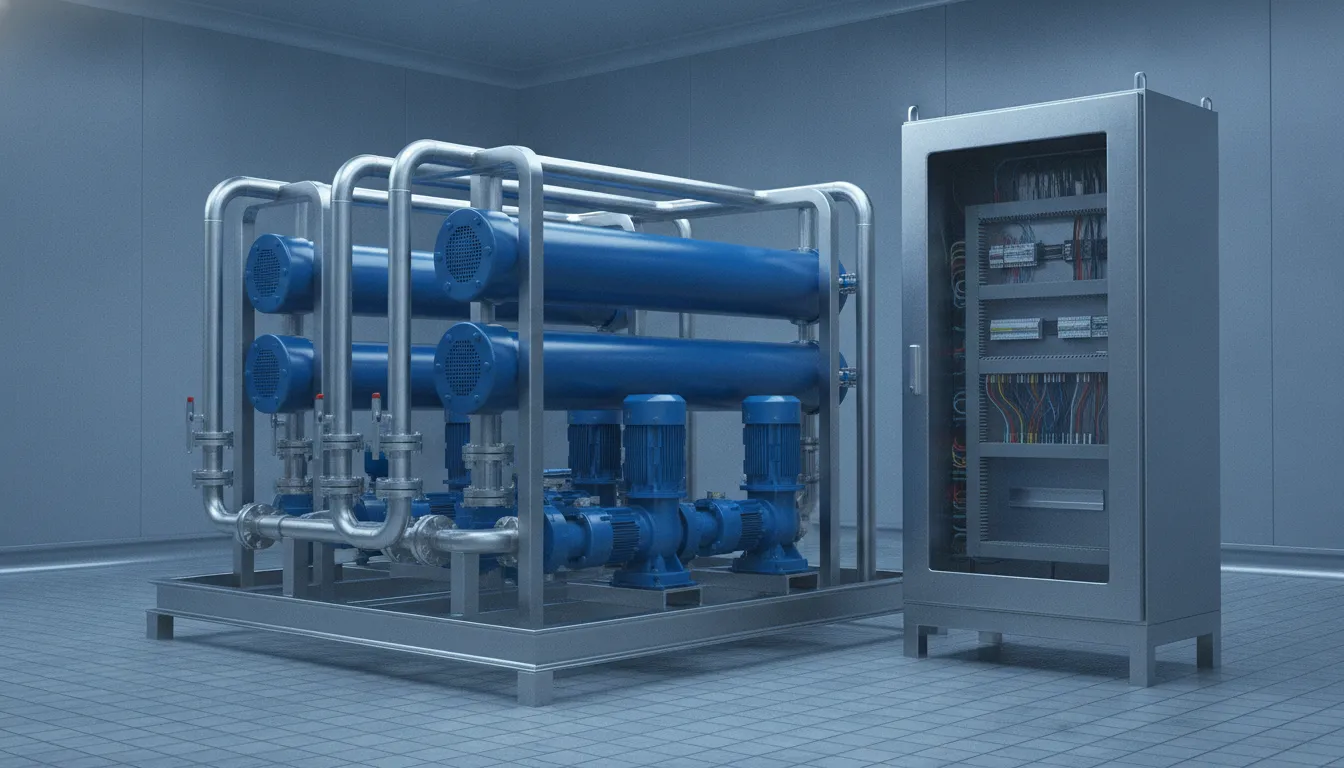
The most accurate option: dosing is corrected against actual water quality — pH, ORP, conductivity. It is this sensor–controller–pump chain that turns dosing from an open loop into a controlled one, and it usually pays back on sites with variable load.
Equipment and material compatibility
Pump type is selected for the reagent, not the other way round. Viscous polymer solutions, aggressive acids and alkalis, reagents that crystallise at low temperature — each has its own requirements for the pump, pipework, tank and seals.
Material incompatibility does not show immediately but through leaks, failures and unplanned stoppages. It is one of those mistakes that costs more than was saved at procurement.
Preparing working solutions
Some reagents are dosed not as concentrate but as a working solution, and preparing it is a separate operation with its own rules. Powder polymers require gradual introduction into stirred water and time to mature: added too fast, they form lumps that never dissolve and block the system.
Working solutions have a limited shelf life. A solution prepared "to last the week" performs worse than fresh by the end of it, and that is blamed on the reagent rather than on how it was made up.
Common mistakes
- Timer dosing under variable load. Permanent overdose in some hours and shortfall in others.
- All reagents at one point. They react with each other rather than with the water.
- No verification of actual delivery. The pump can run while no reagent arrives — a blocked valve or air in the line is discovered from the result, not from an alarm.
- Materials chosen without regard to the reagent. Leaks and failures within months of operation.
- Solution made up in advance. Effectiveness falls towards the end of its shelf life.
- Dose never revisited. Season, a new reagent batch or a changed production programme alter the requirement while the setting stays put.
Frequently asked questions
How do we know the problem is dosing rather than the reagent?
The signal is a result worse than the laboratory jar test showed at the same dose. If the reagent works in the laboratory but not on site, the cause is almost always the injection point, the mixing or the actual delivery.
Is it worth moving to sensor-driven dosing?
On sites with variable load, almost always yes, because reagent savings and stability pay for the package. Where flow is steady the gain is smaller.
Can several reagents share one pump?
Not if they must be injected at different points or at different times. A shared pump removes the ability to tune each reagent separately, which is usually exactly what is needed.
How do we verify the reagent is actually being delivered?
Through residual concentration in the water and by tracking consumption from the tank. A running pump proves nothing on its own.
Getting started
Compare the calculated dose against actual reagent consumption from the tank over a period — a discrepancy immediately shows whether the dosing package has a problem. More in chemical consulting; equipment in equipment; questions through the contact form.