What decides membrane life: pretreatment, antiscalant and dechlorination, operating parameters, the four failure mechanisms, and water conditions in Uzbekistan.
Reverse osmosis is the most common way to produce demineralised water on an industrial site — and the most common source of unpleasant surprises. The membrane block itself behaves predictably; it is the pretreatment in front of it that decides whether the membranes last five years or eighteen months.
Here is what actually drives the life of the unit: the pretreatment stages, the operating parameters worth watching, the four failure mechanisms, and which of them matter most for water in Uzbekistan.
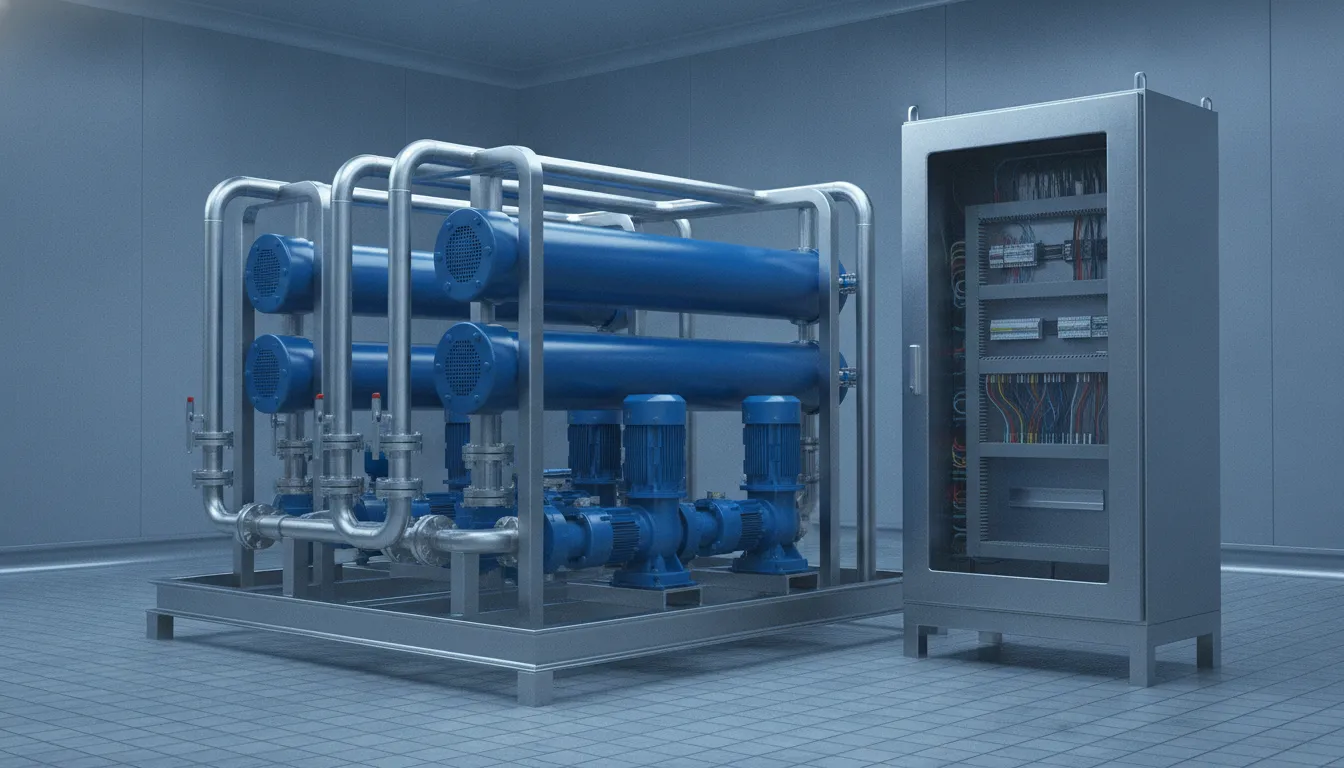
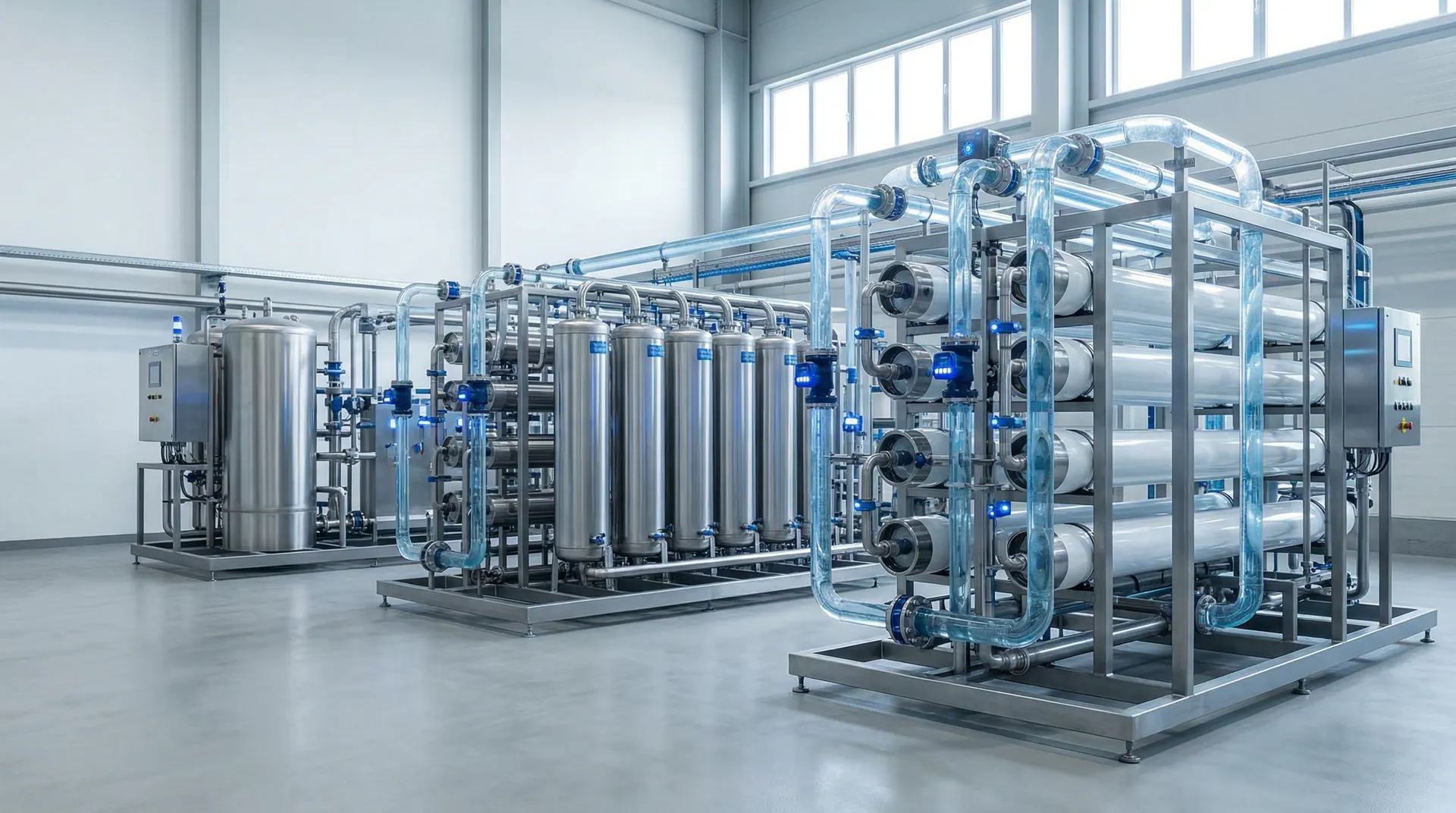
How reverse osmosis works
At a pressure above osmotic, water is forced through a semi-permeable membrane while dissolved salts stay on the concentrate side. Modern membranes reject 97–99.5 % of salts. The feed splits into permeate (treated water) and concentrate (reject). The permeate share of the feed is called recovery, and it determines how hard the membranes work: the higher the recovery, the more concentrated the brine at the last element and the closer it sits to the precipitation threshold.
Pretreatment decides membrane life
Mechanical filtration
A membrane is not designed for suspended solids. Ahead of it you put filter media and 5 µm cartridge filters. The control figure is SDI (silt density index): spiral-wound membranes need SDI below 5, preferably below 3. If inlet SDI is consistently higher, pretreatment is inadequate and no chemistry compensates for it.
Free chlorine removal
Polyamide membranes are destroyed irreversibly by oxidisers. If the feed is chlorinated, chlorine has to be removed before the membranes — with sodium metabisulfite or sodium bisulfite, or through a carbon filter. This is one of the most expensive mistakes to make: an oxidised membrane cannot be recovered by cleaning, only replaced.
Antiscalant
On the concentrate side the solubility of calcium carbonate, calcium sulfate and silica can be exceeded, and salts precipitate directly onto the membrane surface. Antiscalant holds them in solution, allowing higher recovery without scaling. Dose is set from feed water composition and target recovery, typically 2–5 mg/l.
pH correction
Lowering pH shifts the carbonate equilibrium and reduces carbonate scaling risk. On high-alkalinity water, acid dosing works alongside antiscalant, not instead of it.
Operating parameters worth watching
| Parameter | What it indicates | Typical reference |
|---|---|---|
| Recovery | Permeate share of feed | 50–75 % (single stage) |
| Feed SDI | Fouling tendency | < 5, better < 3 |
| Flux | Load on the membrane | 17–25 l/m²·h |
| Differential pressure | Channel blockage | 15 % rise signals cleaning |
| Normalised permeate flow | Membrane condition | 10–15 % drop signals cleaning |
| Salt passage | Membrane integrity | 10 % rise is a warning |
The key word is "normalised". Output depends on temperature and pressure, so raw readings cannot be compared — summer and winter flow differ naturally. Without normalisation, membrane degradation is noticed far too late.
Four failure mechanisms
| Mechanism | Symptom | Prevention |
|---|---|---|
| Scaling | Flow drop, rising salt passage, usually at the last stage | Antiscalant, recovery control, pH correction |
| Particulate fouling | Rising differential pressure at the first stage | Prefiltration, SDI control |
| Oxidation | Sharp rise in salt passage at normal flow | Dechlorination, ORP monitoring |
| Biofouling | Gradual pressure rise, slime on elements | Pretreatment disinfection, no stagnant zones |
The mechanisms differ in their signature, which matters diagnostically: flow loss at stable salt passage means fouling or scaling; rising salt passage at stable flow is almost always oxidation or mechanical damage.
Clean-in-place
Cleaning is triggered by readings, not by the calendar: differential pressure up 15 %, normalised flow down 10–15 %, or salt passage up 10 %. Alkaline cleaning removes organics and biofilm; acid cleaning removes mineral scale. Order depends on the foulant; with mixed fouling you normally start alkaline. A delayed clean costs more, because deposits compact and part of the loss becomes permanent.
What matters for water in Uzbekistan
Groundwater and surface sources in the region often carry high total hardness and elevated sulfate — the scenario where carbonate and sulfate scaling dominate, and antiscalant selection plus a recovery limit become the decisive choices. The second factor is seasonality: the flood period raises turbidity at surface intakes, so pretreatment has to be designed for the worst month rather than the annual average analysis.
Frequently asked questions
What recovery is optimal?
The one that keeps the concentrate below the precipitation threshold of the limiting salt. It is calculated from feed composition: on hard water that may be 50 %, on soft water 80 %. Chasing high recovery on hard water without the calculation leads straight to scaling.
How long do membranes last?
With correct pretreatment and timely cleaning, three to five years. With dechlorination failures, life is measured in months. The figure is set by how the plant is operated, not by the membrane manufacturer.
Can we run without antiscalant?
Only on soft water at low recovery. Otherwise going without means either frequent cleaning or low recovery and a large concentrate discharge — both cost more than the reagent.
Is permeate suitable for boilers directly?
For low and medium pressure boilers usually yes, with residual hardness and alkalinity monitored. High pressure boilers need polishing — a second pass or ion exchange.
Selection and support
Aqua Global selects antiscalant and the dechlorination regime from your water analysis, calculates permissible recovery, and supplies membrane-system reagents from Tashkent stock. See antiscalants and the full range, or send your analysis through the contact form.