Dose, UV transmittance and maintenance: what actually determines UV disinfection performance, and why it complements chlorination rather than replacing it.
Ultraviolet disinfection is attractive for a simple reason: it inactivates microorganisms without adding chemicals, without disinfection by-products, and without changing the taste of the water. That is genuinely true — but only when two conditions are met, and those two are exactly what most installations get wrong: sufficient dose and sufficient transmittance.
Here is how UV actually works, which parameters govern its effectiveness, where it beats chlorine, and where it does not replace it.
How UV disinfection works
Radiation at around 254 nm is absorbed by microbial DNA and RNA and forms bonds between adjacent bases. The damaged strand can no longer be copied — the cell stays physically intact but loses the ability to reproduce. Nothing is added to the water, its chemistry is unchanged, and no disinfection by-products form.
From that follows the main limitation: nothing remains in the water to protect it further downstream. UV disinfects the stream as it passes through the chamber, and that is all.
Dose is the only parameter that matters
Effectiveness is set by dose: irradiance multiplied by contact time, measured in mJ/cm². Different organisms need fundamentally different doses.
| Organism | Indicative dose for 3–4 log | Note |
|---|---|---|
| E. coli, common bacteria | 10–20 mJ/cm² | Most sensitive |
| Cryptosporidium, Giardia | 10–15 mJ/cm² | Chlorine-resistant but UV-sensitive |
| Most viruses | 30–60 mJ/cm² | — |
| Adenovirus | 150–190 mJ/cm² | The most resistant; drives the design |
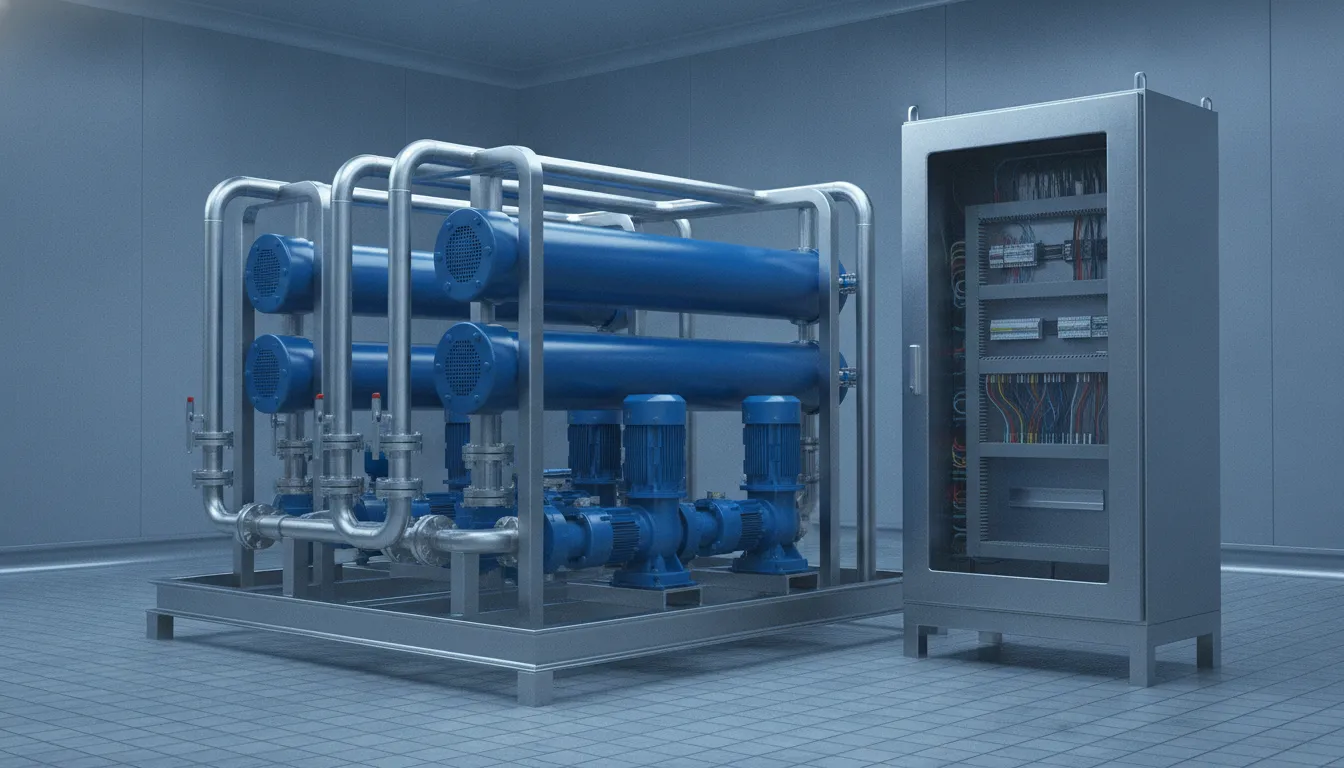
The regulatory dose for potable duty is commonly taken at 40 mJ/cm². Note the adenovirus row: it is exactly why a "UV lamp" from a catalogue and a properly sized UV reactor are different things.
UV transmittance: what usually kills performance
UV transmittance (UVT) is the share of radiation that passes through a 1 cm layer of water. Clean water gives 90–98 %. Anything that absorbs UV reduces the delivered dose at unchanged lamp power:
- Iron and manganese. Strong UV absorbers, and they foul the quartz sleeve at the same time.
- Humic substances. Natural organics from surface sources noticeably reduce UVT.
- Turbidity. Suspended solids shield organisms — a particle physically screens a bacterium from the radiation.
- Hardness. Does not absorb UV directly, but scales the sleeve, so irradiance falls over time.
The practical conclusion: UV goes after mechanical treatment, not instead of it. If UVT is below 75–80 %, either the reactor is designed with a large power margin or filtration is installed ahead of it. Skipping that calculation gives you a unit that formally runs but never delivers the design dose.
UV or chlorine
| Criterion | UV | Sodium hypochlorite |
|---|---|---|
| Residual protection in the network | None | Yes |
| By-products | None | Trihalomethanes where organics are present |
| Cryptosporidium / Giardia | Effective | Poorly effective |
| Effect on taste and odour | None | Yes |
| Sensitivity to water quality | High (UVT, turbidity) | Moderate |
| Main operating cost | Power, lamp replacement | Reagent, storage |
These are complementary rather than competing technologies. A typical working scheme is UV as the primary barrier plus a small dose of sodium hypochlorite to hold a residual in the distribution network. UV handles the chlorine-resistant cysts; chlorine protects the water in the pipework.
Maintenance: three things you cannot skip
Lamp life
A lamp keeps glowing considerably longer than it keeps delivering the required irradiance. Low pressure lamps run roughly 9,000–16,000 hours, medium pressure 3,000–8,000. Replacement is by running hours, not by failure.
Quartz sleeve cleaning
Scale from hardness and iron reduces irradiance gradually and invisibly. On hard water sleeves are cleaned more often; many reactors include automatic mechanical wipers.
Irradiance sensor calibration
The sensor is the only source of information about whether the water is receiving the design dose. An uncalibrated sensor turns the reactor into a device with an indicator instead of a control.
Where UV fits and where it does not
Fits: process water preparation, disinfecting RO permeate, food and beverage water, recirculating systems, final polishing after wastewater treatment, and sites constrained on chlorination by-products.
Does not fit as the only solution: extended distribution networks with no residual disinfectant, low-UVT water without pretreatment, and systems with a high risk of recontamination downstream of the disinfection point.
Frequently asked questions
Does UV change the water composition?
No. pH, hardness, mineral content and taste are all unaffected. That is precisely why UV is used where chemical intervention is undesirable.
Can organisms recover after UV?
Some species have DNA repair mechanisms. That is why the design dose carries a margin over the minimum lethal dose, and why critical sites pair UV with a residual disinfectant.
How do you know the reactor has stopped delivering dose?
From the irradiance sensor, corrected for flow and UVT. If the sensor is uncalibrated or flow has risen above design, dose can be below target while the unit looks perfectly healthy.
Is pretreatment required ahead of UV?
Almost always. Mechanical filtration as a minimum, plus iron removal where iron is present. Installing UV on untreated water is the most common reason people become disappointed with the technology.
Specifying a disinfection scheme
Aqua Global specifies disinfection from your water analysis: dose calculation accounting for UVT and flow, the pretreatment ahead of it, and where needed a UV plus residual disinfectant combination. See disinfection reagents and equipment, or send your analysis through the contact form.