Scaling, corrosion and biofouling in a cooling tower pull in different directions: why fixing one worsens another, and how the balance is built.
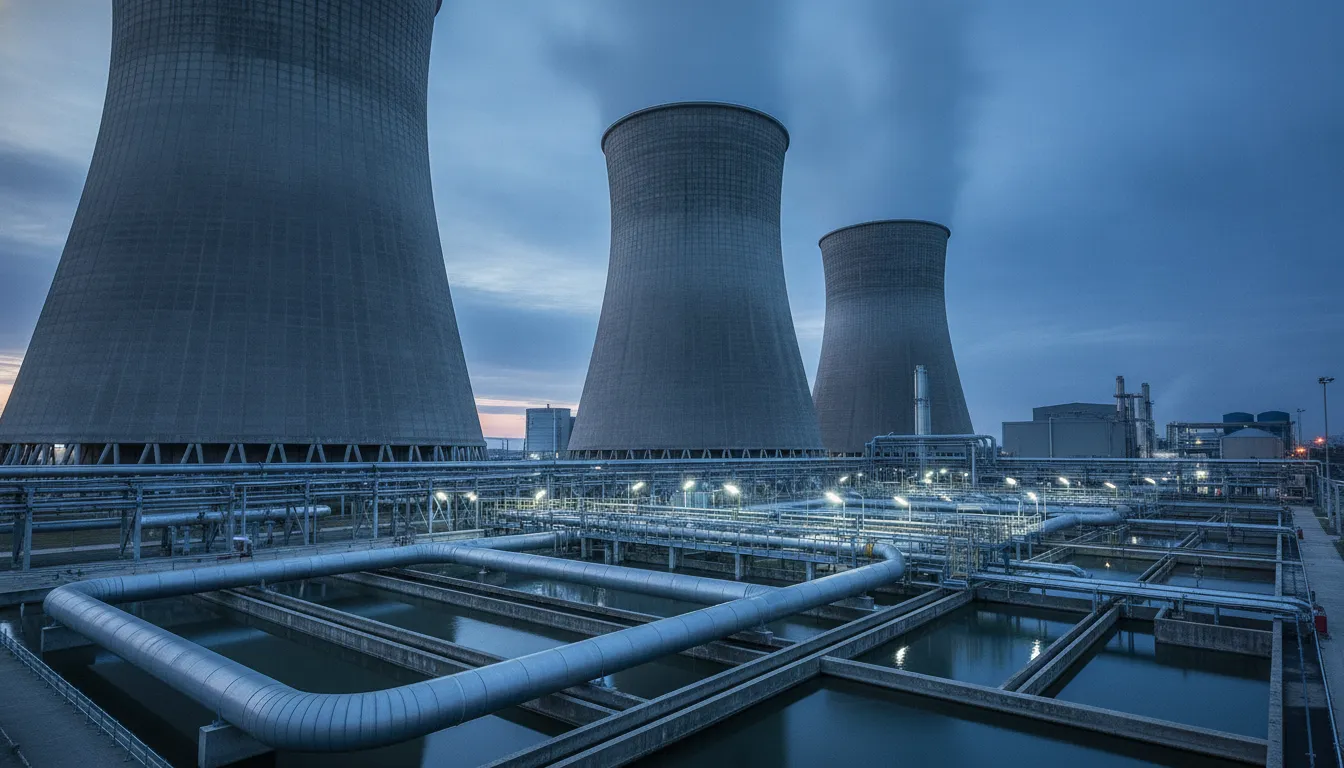
A cooling tower is the one unit on a plant that continuously concentrates everything dissolved in the make-up water. Clean water evaporates; the salts stay behind. That is why a recirculating cooling circuit degrades on its own, with no incident required — it only has to run.
Three processes run in it simultaneously and pull in different directions. Understanding how they interact is what cooling water management actually is.
Three processes that have to be held at once
Scaling
As water evaporates, salt concentration rises until solubility is exceeded and salts deposit on heat-transfer surfaces. Scale acts as insulation: heat transfer falls, compressors and pumps run longer, energy consumption rises. The problem is insidious because it develops gradually and is discovered in the utility bill rather than as a failure.
Corrosion
Recirculating water is oxygen-saturated, warm and carries dissolved salts — an ideal combination for corrosion. It shows up not only as leaks but as corrosion products, which themselves become deposits and fouling nuclei.
Biofouling
Warm water, sunlight, oxygen and airborne organic dust make a cooling tower essentially an ideal bioreactor. Biofilm reduces heat transfer more than mineral scale of the same thickness, shields metal from the corrosion inhibitor, and creates the conditions for localised corrosion beneath itself.
Why they cannot be solved separately
This is where the real difficulty sits. Measures against one process frequently worsen another.
Want less scale — reduce concentration, meaning increase blowdown. But blowdown carries away water, corrosion inhibitor and biocide, raising both make-up and reagent consumption. Want to save water — raise the cycles of concentration, and scaling risk rises immediately. Acidify against carbonate scale — and corrosivity increases. Raise the oxidising biocide dose — and it is consumed oxidising the corrosion inhibitor.
A cooling tower treatment programme is therefore always a balance, not a set of independent decisions. And that is precisely why it cannot be set once and left.
What determines the regime
- Make-up water composition. Hardness and alkalinity determine how far the water can be concentrated before salts deposit.
- Circuit materials. Carbon steel, copper alloys and stainless steel need different inhibition approaches; mixed-metallurgy circuits are their own problem.
- Temperature regime. The hotter the exchanger surface, the higher the scaling risk at that point, even when the bulk water looks fine.
- Air quality. A tower works as an air scrubber: dust and organics from the site enter the water and feed microorganisms.
- Season. Summer brings higher temperature, more evaporation and more biological activity. A winter setting does not work in summer.
What gets monitored in circulating water
Control is by readings, not by calendar. The basic set is dissolved solids as a measure of cycles of concentration, pH, indices reflecting the water's tendency to scale or corrode, residual reagent concentrations, and the microbiological picture.
The key point is that the trend matters more than any single value. Steadily rising dissolved solids at unchanged blowdown means something changed in make-up or evaporation. Residual biocide falling faster than usual signals rising biological load long before visible slime appears.
The reagent programme
A typical programme includes a scale inhibitor, a corrosion inhibitor, a dispersant and a biocide. Scale control uses antiscalants, metal protection uses anti-corrosion reagents, pH correction uses pH regulators, and microbiological control uses disinfectants — usually alternating oxidising and non-oxidising chemistry so a resistant population does not establish.
Make-up water often needs its own preparation, whether softening or filtration. That is a separate task, but it directly determines how complex the in-circuit programme has to be: the better the make-up, the simpler the regime.
Common mistakes
- Blowdown is set by eye. Without reference to actual dissolved solids it is either excessive — losing water and reagent — or insufficient, and scale grows.
- The same biocide is dosed continuously. A resistant biofilm establishes. Alternating actives is part of the programme, not an option.
- The programme is not revisited between seasons. A setting that worked in winter produces both scale and biology in summer.
- Bulk water is used as the reference instead of the exchanger. Bulk readings can look fine while the hottest surface is already scaling.
- Falling efficiency is blamed on the equipment. Most often it is scale or biofilm, not machine wear.
Frequently asked questions
Can cycles of concentration be raised to save water?
Yes, but within the limit set by make-up water composition. The limit is calculated from the water's scaling tendency; exceeding it means water savings are paid for in scale and lost heat transfer.
How do we know scale is forming if everything looks normal?
From indirect signs: falling heat transfer, rising energy consumption at the same load, increasing pressure differential. The direct method is inspecting heat-transfer surfaces during a shutdown.
Does make-up water need treating?
It depends on its composition. On hard water, treatment usually pays back: it allows operation at higher cycles of concentration, which saves both water and in-circuit reagent.
How often should the programme be reviewed?
At every season change, and also when load, make-up composition or operating pattern changes, or after any significant shutdown. A programme untouched for a year is almost certainly running off-optimum.
Getting started
Start by analysing make-up and circulating water at the same time — comparing those two samples immediately shows the actual cycles of concentration and how far it sits from design. More on the approach in water treatment; questions through the contact form.