
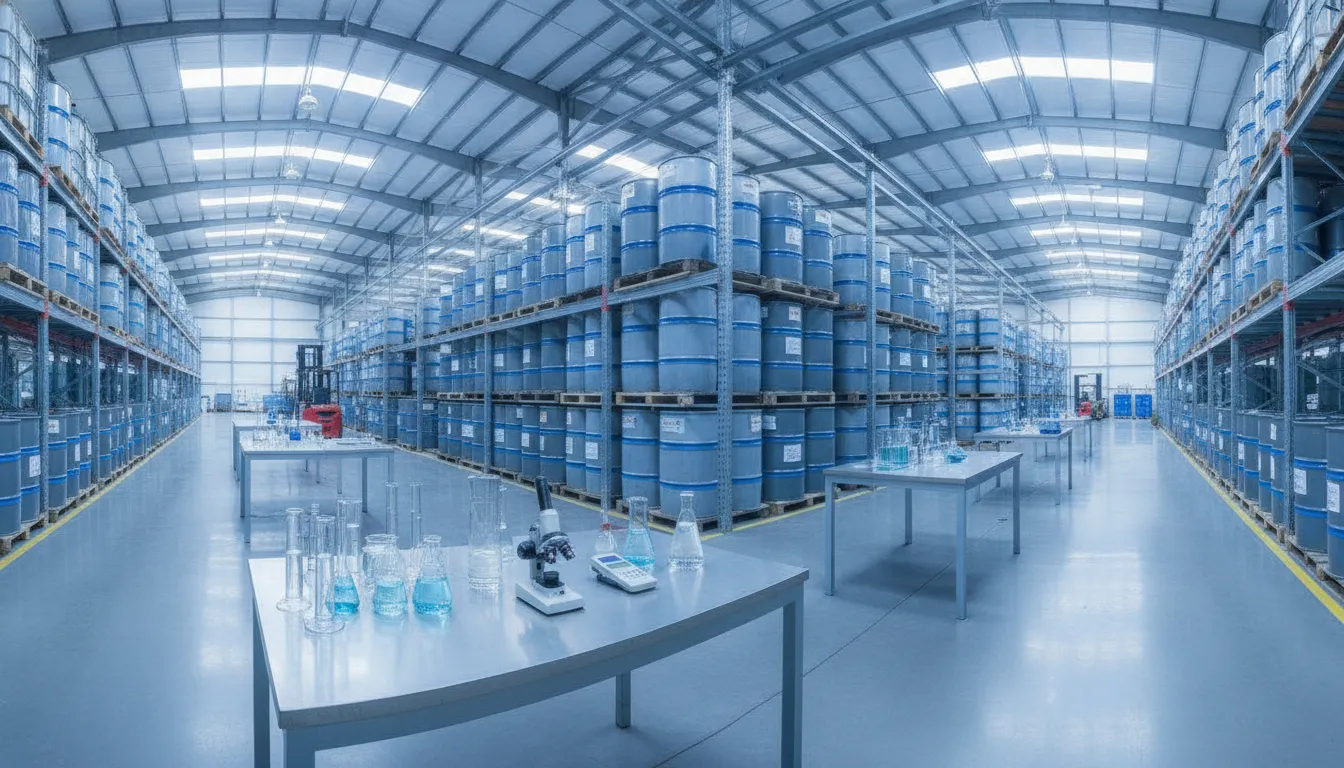
Where water treatment on a plant actually starts
Almost every failed water treatment project starts the same way: the system is chosen before the water is understood. Equipment gets ordered by analogy with a neighbouring plant, and then it turns out the source is different, the load is different and the shift pattern is different. Rework costs more than getting the selection right in the first place.
So the work starts with two questions rather than an equipment catalogue: what water arrives at the site, and what water does the process need. The gap between those two points is the actual brief. Everything else is a way of closing it.
What a water treatment system is made of
Industrial water treatment is not one machine but a sequence of stages, each removing its part of the load and preparing the water for the next. A skipped stage almost always shows up at the following one: solids that were not removed blind the filter media, hardness that was not understood destroys membranes.
Mechanical filtration
The first line of defence. It removes suspended solids, sand, scale and corrosion products from the pipework. It looks like a simple stage and is the one most often underestimated: everything downstream is designed for water that has already been mechanically prepared. Selection follows the nature of the load and how stable the source is across the year.
Clarification and iron removal
A typical regional problem on groundwater sources. Dissolved iron and manganese are invisible in a freshly drawn sample but oxidise on contact with air, producing colour, deposits and pipework fouling. It is solved by oxidation followed by filtration; the specific arrangement depends on the form the iron is in and what else it comes with.
Softening and demineralisation
Hardness is the main enemy of heat-exchange equipment and membranes. For boilers, steam generators and cooling systems, softening is not optional — scale eats heat transfer and equipment life. Where deeper preparation is required, a membrane stage covers it. The choice between ion exchange and membranes follows the process requirement, not which technology is newer.
Disinfection
Needed wherever water touches product or people, or where biofouling can develop in the system. The approach depends on whether a residual is required in the distribution network: if water travels through extended pipework, a single barrier at the treatment point is not enough. More in disinfection reagents.
Reagent dosing
This is what ties the scheme together. A reagent injected at the wrong point or in the wrong regime does not work, regardless of the quality of the reagent itself. The dosing package is designed with the scheme, not bought after commissioning. The range is in products.
How we run the work
1. Water analysis and site survey
A representative sample, plus an understanding of how the site actually runs: daily variation, seasonal swings in the source, shift patterns, expansion plans. A sample taken at a convenient moment rather than at peak load produces a system that fails exactly when it is needed.
2. Scheme selection and laboratory testing
The sequence of stages is set and reagents are selected — tested on your water, not chosen from a manufacturer's table. This is also where the likely operating cost becomes visible, not just the equipment cost. The difference between those two figures usually decides whether the solution pays back.
3. Technical solution and specification
Scheme, equipment list, and requirements for the site, power supply and pipework. This is also where what the system must deliver gets written down, so expectations do not diverge after start-up.
4. Supply, installation and commissioning
Bringing the system to its working regime and tuning dosing against the actual water. Design parameters are almost always adjusted on site: real water differs from the sample, and that is normal.
5. Ongoing support
Regular reagent supply, dose review when the season or production programme changes, and support when readings drift. A system set once at commissioning and then left alone starts drifting within the first year.
What determines the scheme
- The source. Groundwater, surface water or municipal supply are three fundamentally different problem sets. Surface sources bring seasonal swings; groundwater brings dissolved iron and higher hardness.
- Process requirements. Water for a boiler house, for a membrane unit, for food production and for washing are different requirements. Treating all water to the strictest one is expensive and usually unnecessary.
- Demand variability. A system sized on average hourly flow will not survive a peak shift. Margin is set against the real profile.
- What happens in three years. Expansion plans are cheaper to allow for in the layout now than to retrofit later.
- Who will operate it. Complex automation without trained people on site reverts to manual operation within months. The system has to stay manageable by the team that actually works there.
Sector specifics
The water problem is phrased differently depending on the production. In textile, dyeing water preparation and stable hardness are critical. In food production, safety and documentation requirements are added. In power and heat, protecting heat-exchange equipment comes first; in mining, it is high salinity and large volumes. The full list is in industry solutions.
Frequently asked questions
Can an existing system be upgraded instead of replaced?
In most cases yes, and it is often the better route. A significant share of problems is solved by revising the reagent scheme and dosing regime without changing equipment. The right starting point is a survey of the existing plant, not a design for a new one.
How long does selection take?
An initial assessment from a water analysis is quick. Laboratory reagent selection takes a few days. Design and supply timescales depend on scale and are agreed separately.
What do you need to start the conversation?
A water analysis if you have one, the flow, the intended use of the treated water, and an understanding of how the site runs across a day. If there is no analysis, we start with sampling.
Do you work outside Tashkent?
Yes, across all regions of Uzbekistan. Logistics and site visits are arranged per project.
Getting started
Describe the site and attach a water analysis if you have one — that is enough for an initial assessment and a view on which scheme makes sense. Write to us through the contact form.